

In recent classes, Lambros Kallianiotis Renshi has been returning to two fundamental ideas: kamae and maai.
At first glance, they appear simple — a stance and a distance — concepts we have all practised for many years.
However, the way they are being taught reminds us that this is not beginner material. This is where training becomes honest.
As Lambros Kallianiotis Renshi emphasises:
“When you step into kamae, you must already be at the correct distance.”
Not close. Not far. Exactly where your technique can work.
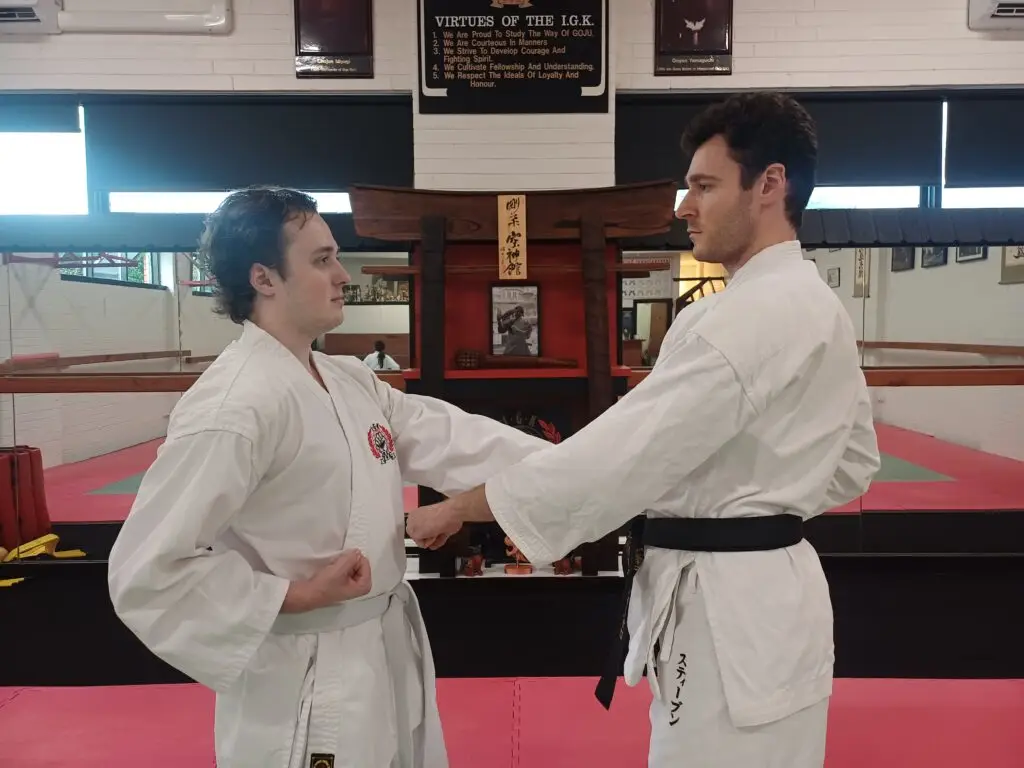
A common issue is stepping too short, remaining out of range, and then delivering a punch that falls short. In this situation, there is no requirement for the partner to block.
As he puts it:
“Why should I waste my energy?”
The problem is not the punch — it is the entry. Kamae is not simply a posture. It is a commitment.
When we step into kamae — in kihon, kata, or kumite — we are declaring readiness. Not adjusting, not hesitating, not arriving loosely. Ready.
When this moment is casual — when the body is loose, the arms lack structure, the eyes wander — the training has already been compromised.
As John Ross Kyoshi reminds us:
“The mental side of training is just as important as the physical. Discipline is what keeps you present.”
Kamae is that point of presence — where body and mind align.
If kamae is how we arrive, maai is where we are.
Maai is often described as distance, but it is more accurately the relationship between distance, timing, and intent. It is the ability to step into range without adjustment.
A simple test: If you step and punch, does it land at full extension?
If it falls short, you were not in range. If you need to reach or lean, your structure is already compromised.
Lambros Kallianiotis Renshi reinforces this principle:
“Don’t step in and then adjust. Step in at the correct distance.”
This is where the “eye” becomes critical — the ability to judge space accurately and instantly.
Adjusting for your partner
Maai is not fixed. It changes with every partner.
A shorter person facing a taller partner with longer legs cannot use the same distance. The longer reach — particularly with kicks — changes the equation.
As Lambros Kallianiotis Renshi points out, both partners must adjust. The shorter person may need to close distance more carefully, while the taller person must be aware of their extended range and not rely on it blindly.
The same applies in structured drills. Kicking sequences, in particular, must be adapted to reflect realistic distance. A longer-legged partner will reach further, and the sequence must allow for that variation.
There is no single “correct” distance — only the correct distance for that moment, with that partner.
There is also the concept of aiming beyond the target.
We are encouraged to focus slightly past the point of contact — not to strike harder, but to ensure the technique is complete.
When we aim at the target, the movement often shortens. When we aim through the target, the technique reaches its natural extension.
The result is simple — the partner must respond.
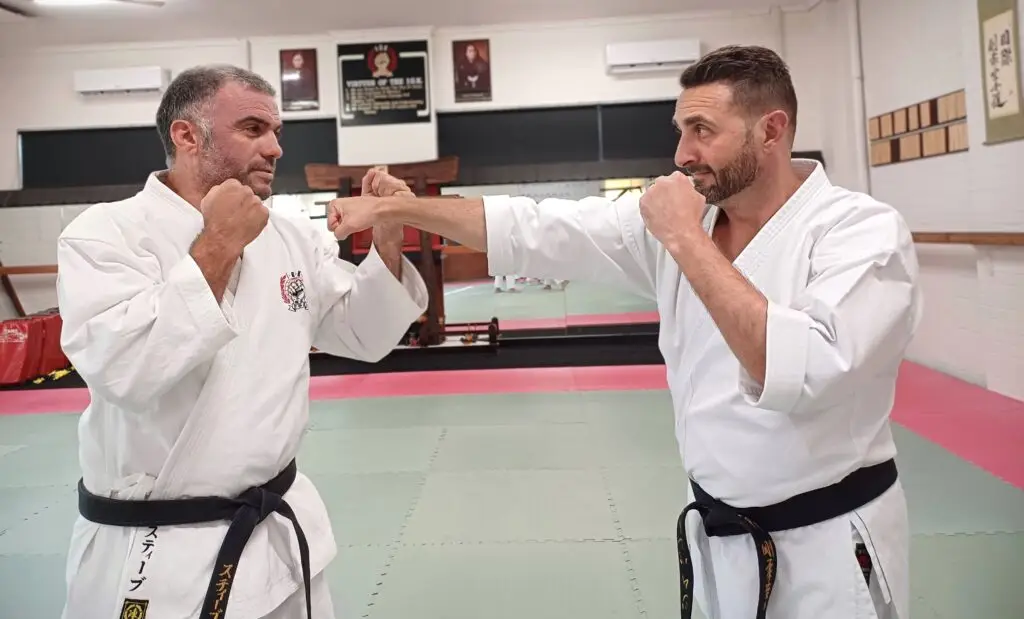
As Lambros Kallianiotis Renshi states:
“If your technique doesn’t make your partner move, they are not learning.”
And neither are you. This brings an important level of honesty to training.
If we are not genuinely trying to strike — with control, but with intent — then we are not providing our partner with a real situation.
In his words, we are “cheating each other.”
Good training exists in a narrow space: real distance, real intent, and full control. Enough to require a response — without causing harm. These principles apply equally in kata and kihon.
As Lambros Kallianiotis Renshi reminds us, we must step into kamae with the same intent, even when training alone.
There is no separate “practice mode.” The body learns what it repeats. Loose practice produces loose application.
These concepts are simple, but not easy. They require precision, awareness, and discipline. They ask us to be present — from the moment we step into kamae — and to ensure that every movement has meaning.
That’s where training becomes real.