

It began, somewhat unexpectedly, in a car park.
Driving in, there were arrows painted on the concrete pillars—some pointing upward, others directing you downward. They were simple, functional markings, but the image stayed with me longer than it should have. There was something quietly instructive about them. Even in that ordinary setting, the message was clear: you are always being directed somewhere. There is no standing still.
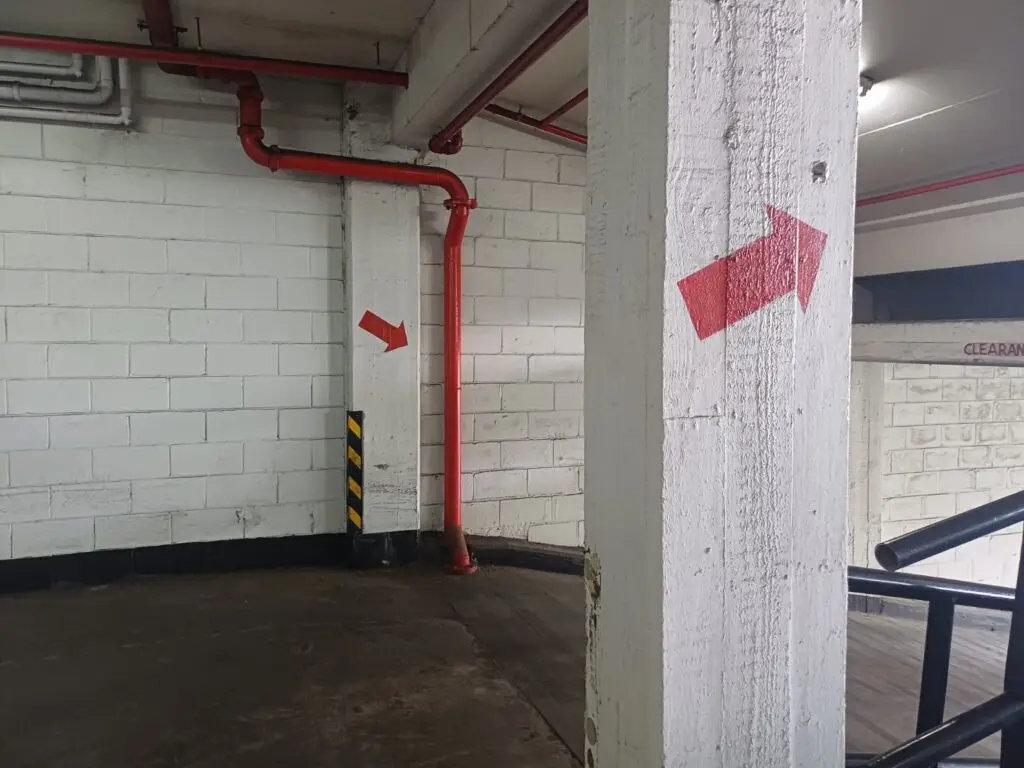
That thought returned later that evening in the dojo, where the same idea seemed to take on a deeper meaning.
There are nights when training has a certain energy to it. You can hear it in the room before you fully notice it. Techniques finish cleanly, there is sharpness in the movement, and the whole class seems connected by a shared sense of purpose. Even simple drills feel alive.
And then there are other nights, where everything appears correct on the surface. The sequences are remembered, the positions are reached, and the class moves together as expected. But something is missing. Not in a way that is obvious or wrong—more that the movement hasn’t quite come to life.
Lambros Kallianiotis Renshi paused the class recently and spoke about this very point. He wasn’t referring to any one individual, but rather to a stage of training that most students pass through at some time. It is possible to attend regularly, to be consistent, and to know the material well, and yet still feel that the quality of the movement has not shifted.
The technique is there, but it remains careful rather than decisive. The kata is performed, but without the change in tempo or intensity that gives it character. It is not a lack of effort so much as a lack of expression.
What Lambros Renshi was pointing toward was the moment where that begins to change—where the movement is no longer simply guided through its pattern, but starts to be delivered with intent. It is a subtle shift, but an important one. The body responds more directly, the technique finishes with clarity, and there is a sense that the movement has purpose behind it.
He often reminds students that focus is central to this process. Without it, training can easily become mechanical. With it, even the most basic movement begins to take on a different quality.
John Ross Kyoshi has long reinforced the same principle from another angle. In kihon and kata, even when training alone, each movement is expected to carry meaning. The step into kamae is not simply a transition between positions; it establishes readiness. A block is not placed passively; it is performed with awareness of distance and timing. A strike is not an isolated action; it is part of a sequence that reflects intent.
When that awareness is present, the technique feels grounded and complete. Without it, the movement may look similar, but it lacks weight.
With gradings approaching, this distinction becomes more important. Instructors are not only observing whether students remember what to do, but how they do it. They are looking for signs that the training has begun to take shape internally—through focus, commitment, and clarity of movement.
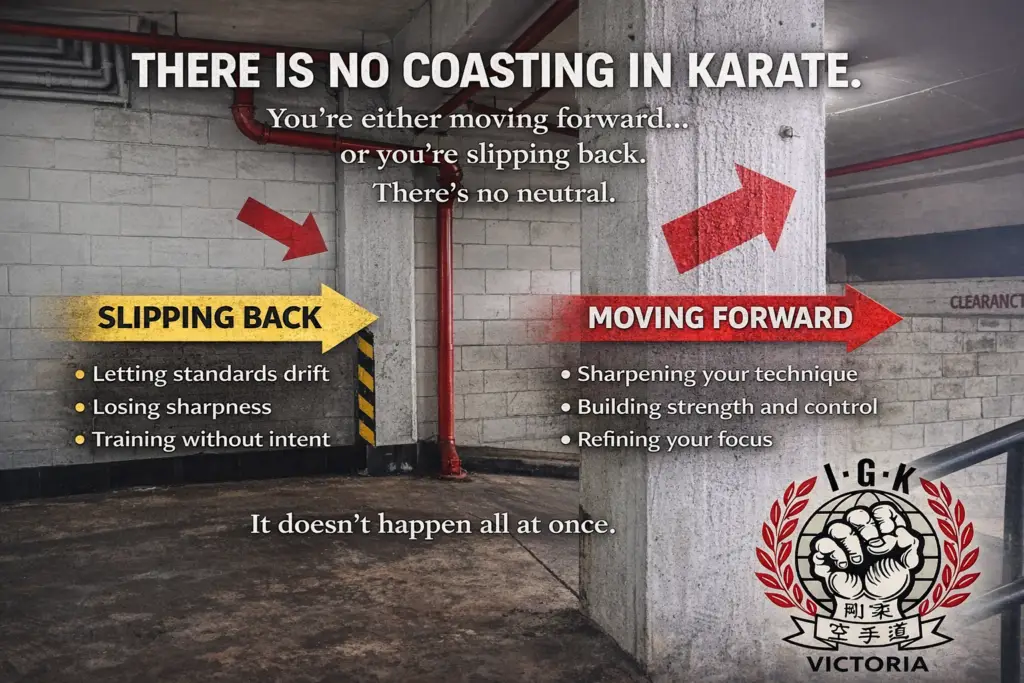
This does not require dramatic change. More often, it is seen in small adjustments: a technique that finishes more cleanly, a stance that is held with greater control, or a moment of stillness that shows composure before the next movement begins. These are the details that indicate direction.
Many students arrive at training after long hours of sitting, and it is not always easy to shift immediately into this state. The body can feel slow to respond, and the mind takes time to settle. Part of training, then, is learning how to make that transition—to move from stillness into purposeful action.
Over time, these small changes accumulate. Progress in karate is rarely dramatic in the moment. It is built gradually, through repetition and attention, until the difference becomes clear in hindsight.
The difficulty is that the opposite is also true. When attention fades, or movements are repeated without intent, there can be a gradual loss of sharpness. It is not something that happens suddenly, but rather something that develops quietly if left unaddressed.
This is why the idea from that car park continues to resonate. The arrows did not allow for ambiguity; they simply indicated direction.
Training works in much the same way. Whether we are aware of it or not, we are always moving in a direction shaped by the quality of our practice.
As students prepare for grading, it may be helpful to reflect on this. Not only on what has been learned, but on how it is being expressed. Is there intent behind each movement? Is there clarity in the way techniques begin and end? Is there a sense of presence in the performance?
These are the qualities that instructors recognise. Not perfection, but direction.
In that sense, there is no real coasting in karate. There is only the ongoing process of refinement, where each class offers an opportunity to move a little further forward.