

In the dojo we regularly return to two key concepts: Sanchin and Zanshin. They are not decorative terminology. They are practical training tools.
When we step into kamae before pre-arranged sparring or free kumite, the instruction is consistent: have Zanshin. Do not look around. Do not break eye contact. Do not let your attention wander.
You are present. You are ready.
This is particularly important today, when distraction is constant. Younger students especially can struggle to maintain steady focus. In karate, even a brief lapse in attention has consequences. Zanshin trains us to remain alert before the first movement, during the exchange, and after it concludes.
You bow with awareness.
You step into kamae with intent.
You finish the technique without mentally switching off.
That habit of sustained attention becomes part of character. It transfers directly into study, work, driving, conversation and responsibility. Presence is not accidental. It is trained.
If Zanshin is awareness, then Sanchin is discipline under pressure.
Sanchin is often translated as “three battles,” and Lambros Renshi has explained their order clearly in class.
The first battle is the body — overcoming physical fatigue.
The second battle is the mind — maintaining focus and discipline when the body begins to hurt.
The third battle is the spirit — the willpower, the intestinal fortitude to persevere through physical pain, fatigue and mental distraction.
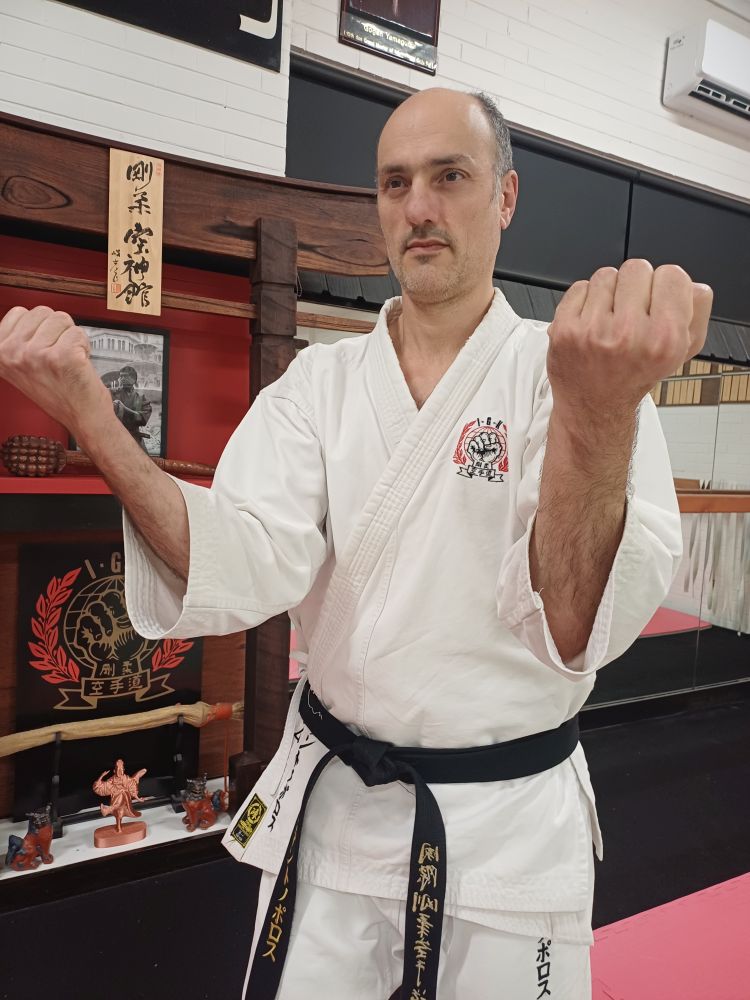
When you stand in Sanchin and your legs begin to shake, that is the first battle. The body wants relief.
When you choose not to step out, and instead concentrate on posture and breathing, that is the second battle. The mind must remain steady while the body is uncomfortable.
When both fatigue and distraction build, and you push through calmly and deliberately — that is the third battle. Spirit takes over.
If practised correctly, you move beyond simple endurance. You move past the immediate awareness of discomfort and reach a deeper internal strength. The breathing stabilises. The posture holds. The mind quietens.
This is where the concept of Mushin — “no mind” — begins to appear. Not empty or careless, but free from panic, complaint or hesitation. Focused. Controlled. Present.
These battles are not confined to the dojo.
In study, the body grows tired first.
Then the mind looks for distraction.
Then the spirit decides whether the work is completed.
In training, fatigue comes before loss of concentration.
In life, pressure tests discipline before it tests character.
The structure of Sanchin gives us a framework to handle all of it.
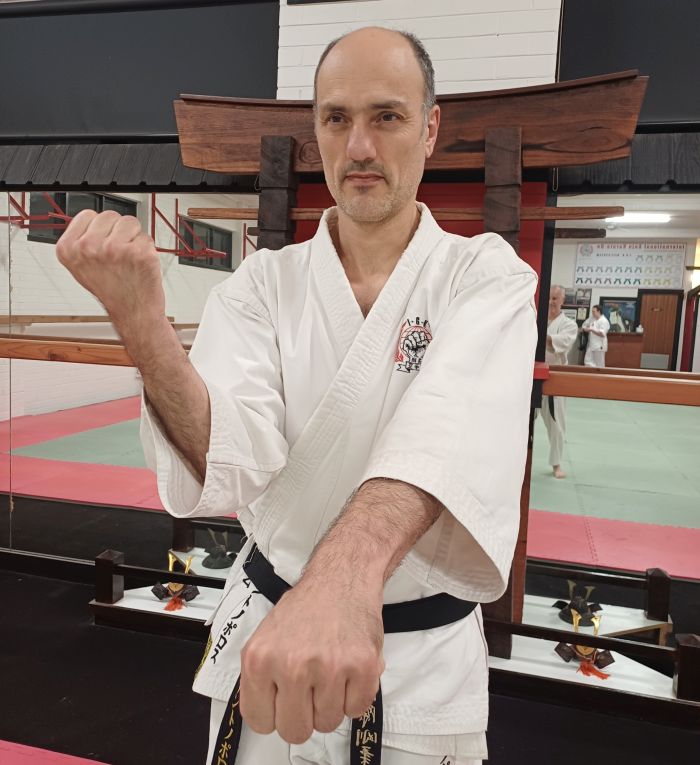
Zanshin teaches us to remain aware.
Sanchin teaches us to endure and organise ourselves under pressure.
Lambros Renshi often reminds us, “Goju has all the answers. Think about its principles first and the answer will always lie before you.”
When facing distraction — return to Zanshin.
When facing fatigue — return to Sanchin.
When facing uncertainty — return to balance, breath, structure and awareness.
The principles are already in the training.
Our responsibility is to apply them — consistently, inside and outside the dojo.
Osu.