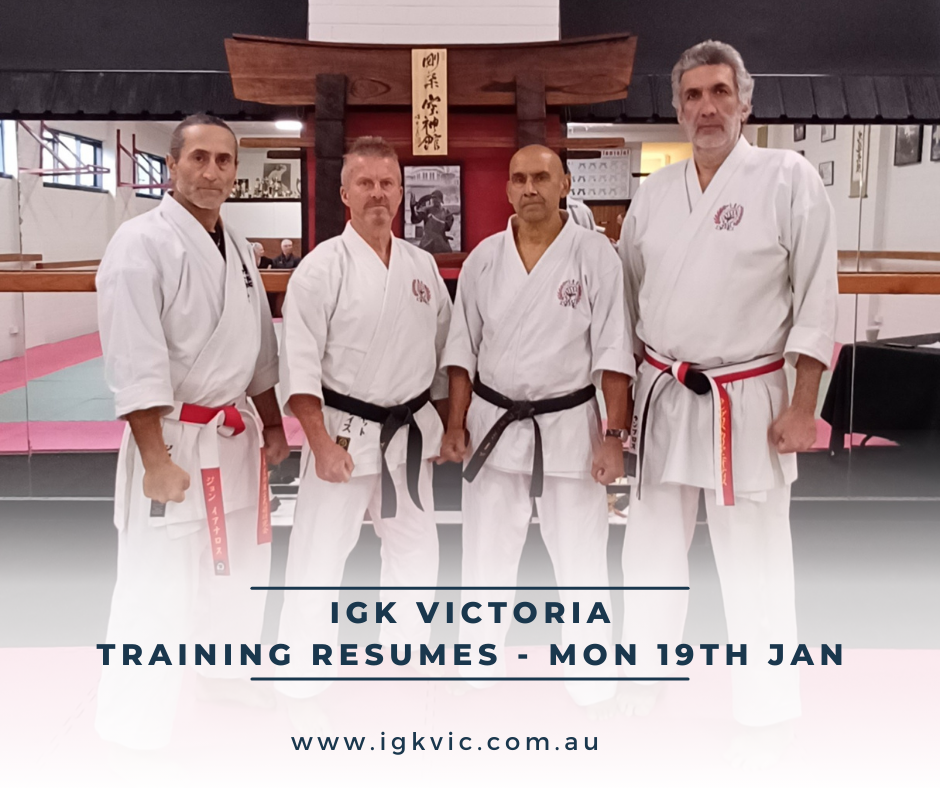

At the beginning of the year, something subtle but important happens on the dojo floor.
It doesn’t matter whether you’re tying a white belt for the first time or wearing a black belt you’ve earned over many years — after a break, everyone begins again.
That isn’t a step backwards.
It’s the opportunity.
White Belt Mind Is Not About Rank
White belt mind has nothing to do with the colour of your belt.
It’s a mindset — one that allows you to:
- Pay attention again
- Accept correction without defensiveness
- Let go of how things used to feel
- Train what’s actually in front of you, not what you think you should already know
After time away, the body is honest. Timing is off. Stances feel heavier. Breath runs out sooner. That honesty can bruise the ego — or clear it.
When the ego softens, learning accelerates.
An old Okinawan saying captures this simply:
“The beginner’s mind has many possibilities. The expert’s mind has few.”
Emptying the Vessel
One of the hardest things for experienced students is not learning something new — it’s unlearning assumptions.
There’s a quiet discipline in starting again:
- Slowing movements down
- Rebuilding from basics
- Letting go of “I should be better than this”
- Emptying the vessel so it can be filled properly
From long experience, starting from scratch — even briefly — sharpens everything that follows. Karate doesn’t punish humility. It rewards it.
Why Seniors Are Encouraged Back to Basics
In this dojo, senior students are encouraged to train in junior classes from time to time.
Not to supervise.
Not to demonstrate authority.
But to go back through basics with care and precision.
Basics expose everything:
- Stance depth
- Weight distribution
- Hand position
- Balance, breath, and focus
There’s nowhere to hide in fundamentals — and that’s exactly why they matter.
As Lambros Kallianiotis Renshi regularly reminds students:
“The higher your level, the more responsibility you carry for your basics.”
When senior students drift, shortcuts creep in quietly. And when a black belt forgets basics or needs repeated correction on fundamental movements, it’s taken seriously — not out of anger, but out of respect for the art.
Rank doesn’t excuse inattention.
Experience doesn’t replace discipline.
White Belt Mind Is a Senior Skill
It takes humility to step back into basics once you’re experienced.
It means:
- Being corrected without resistance
- Slowing down instead of powering through
- Letting go of reputation
- Training detail over display
That isn’t beginner behaviour.
That’s senior behaviour done properly.
As John Ross Kyoshi has often said in different ways:
“Karate never stops asking questions. If you stop listening, it stops working.”
The irony is simple:
The more advanced the karate, the more basic it becomes.
What Juniors Learn by Watching Seniors
When juniors see senior students train basics seriously — not casually — the culture of the dojo is set without a word being spoken.
They learn that:
- Fundamentals are lifelong
- No one is above correction
- Effort matters more than rank
- Mastery is built layer by layer
This is how standards are transmitted — not by speeches, but by behaviour.
A Quiet Reset for the Year Ahead
Early-year training isn’t about brute intensity.
It’s about:
- Listening more than forcing
- Rebuilding timing before speed
- Letting the nervous system settle back into rhythm
- Allowing progress to return naturally
When students adopt white belt mind, improvement comes faster — and stays longer.
An old karate principle sums it up neatly:
“Train as a beginner. Refine as a master.”
Step Back Onto the Floor
Every year offers the same invitation.
Tie your belt.
Step onto the floor.
Bow in.
Not as the person you were last year —
but as someone willing to learn again.
That mindset never stops being powerful.