

Where Training Begins
IGK Victoria – North Balwyn Dojo
For over 55 years, legs have been burning upstairs in the dojo at North Balwyn.
Students stand in silence, eyes fixed forward—or sometimes drifting—wondering if the instructor is behind them, watching with quiet intent.
The stance feels strong at first. Then the burn begins. Focus wavers. The mind looks for a way out.
And that is the moment where training truly begins.
At IGK Victoria, this has always been understood.
Not when the body is fresh.
Not when everything feels comfortable.
But when the effort becomes real.
The Cat Stance
The room has gone quiet.
A line of students stands across the dojo floor in Neko Ashi Dachi—the cat stance. One leg bearing the weight, the other light, ready, almost hovering.
At first, it looks simple.
Then the burn begins.
It starts in the calf, then creeps into the thigh until the supporting leg begins to tremble. Small adjustments appear. A heel lifts slightly. A posture rises just enough to ease the load.
At the front, John Ross Kyoshi says nothing.
“Stay.”
That is all.
The room settles again. Breath becomes audible. Thoughts creep in.
How much longer?
Surely this is enough…
Across the floor, Lambros Kallianiotis Renshi moves quietly between the students.
A light touch on a shoulder. A small adjustment of a foot.
“Relax,” he says softly. “Not collapse—relax.”
The trembling doesn’t stop.
But something changes.
The students stop fighting the feeling. They stand with it.
Then John Ross Kyoshi speaks again.
“It’s mind over matter,” he says.
“I don’t mind if it hurts… so it doesn’t matter.”
There is a ripple—almost a smile—through the line.
The legs are still burning.
But now, no one moves.
Stay Down
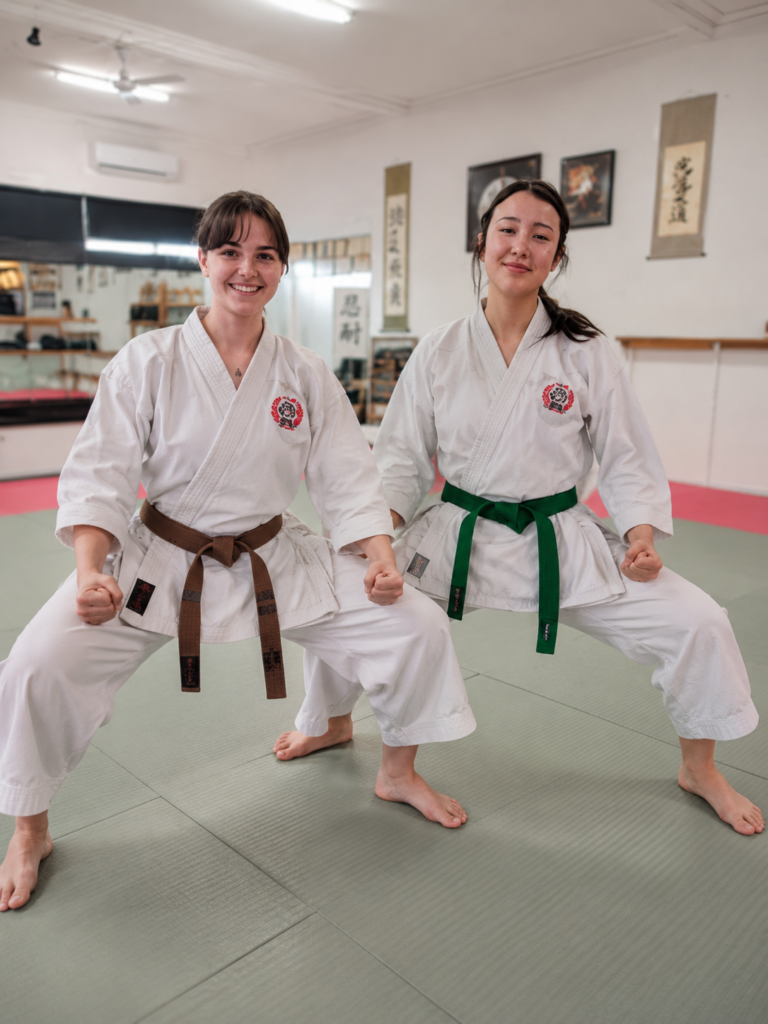
Later, the class moves into kata.
Slowly.
At IGK Victoria, kata is often performed this way—deliberate, controlled, with no momentum to hide behind.
Every movement is exposed.
They drop into Shiko Dachi.
Wide stance. Hips low. Knees pushing out.
At first, it feels strong.
Then the burn comes—deep through the thighs, heavy and persistent.
A few students rise slightly, almost unnoticed.
From the front of the room, Lambros Kallianiotis Renshi’s voice cuts through.
“Stay down.”
The room tightens again.
“Feel it burn. Don’t lose focus.”
The kata continues—slow, controlled, unforgiving.
A punch extends and holds.
“This is when it counts.”
The words land differently now. Not at the beginning—when everything is easy—but here, when the legs are heavy and the mind starts to drift.
The stance doesn’t change.
The burn doesn’t leave.
But something steadies.
The students stay down.
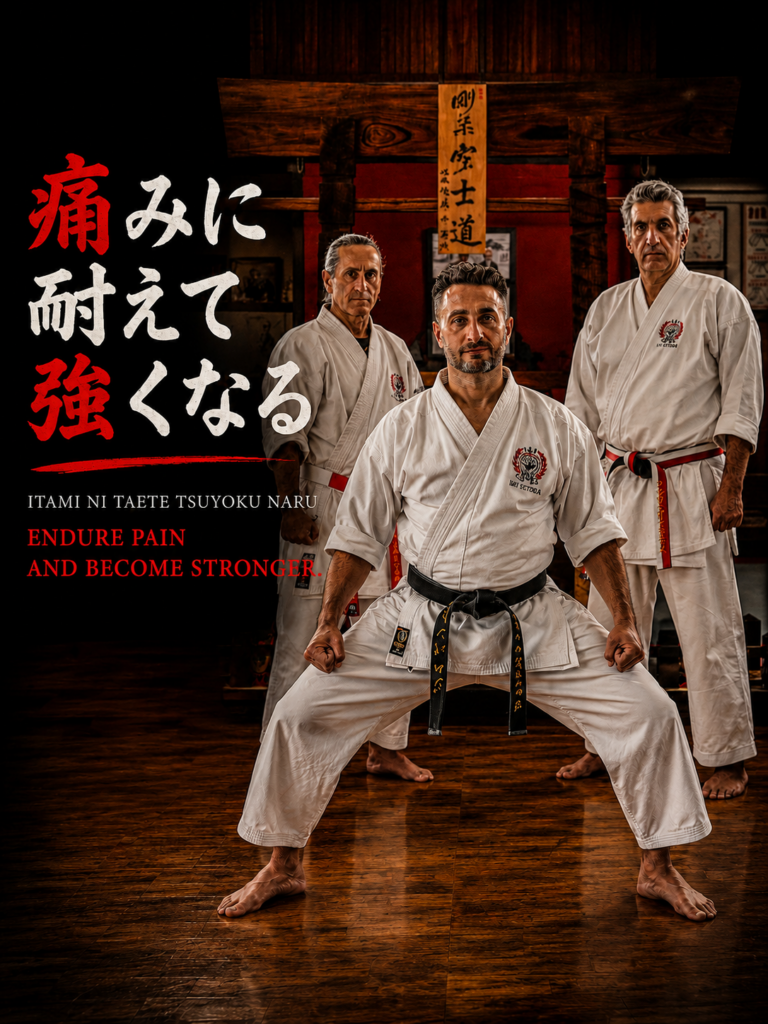
Understanding Discomfort
For those observing training at IGK Victoria—particularly parents—it’s important to understand what is happening in these moments.
There is a clear difference between discomfort and injury.
- The burn in the muscles
- The fatigue that builds in the legs
- The challenge of holding posture
These are normal parts of training. They are how strength, endurance, and control are developed.
Sharp pain, joint strain, or anything that feels wrong is treated differently. Students are guided, corrected, and, when needed, stopped.
The goal is not to push through injury.
The goal is to learn how to work within safe limits, while gradually expanding them.
Why It Matters
In the dojo at North Balwyn, this lesson has been repeated for decades.
When a stance begins to break under fatigue, something important is revealed.
Technique that looks correct when fresh often changes under pressure. Posture rises. Weight shifts. Focus slips.
This is not failure.
This is feedback.
As John Ross Kyoshi often reminds students, if the stance changes when you are tired, it was never truly stable to begin with.
And as Lambros Kallianiotis Renshi teaches, everything is in the kata—including how you stand when you don’t want to stand anymore.
The Lesson Beyond the Dojo
One of the most valuable aspects of training at IGK Victoria is what it reveals.
If your legs give out early in Shiko Dachi, or your balance falters in Neko Ashi Dachi, the body is telling you something.
It is not random.
It is specific.
It shows you where you need to work.
Students often take this lesson beyond the dojo:
- Strengthening the hips
- Practising squats and lunges
- Improving balance and control
Not because they are told to… but because they have felt where they are lacking.
No one enjoys being “found out” in class.
And so, quietly, they prepare.
In this way, discomfort becomes something positive.
It doesn’t discourage—it directs.
For Younger Students
For children training at IGK Victoria in North Balwyn, these lessons are introduced carefully.
They are not asked to endure beyond their capacity.
They are guided to experience effort in a safe, supportive environment.
They learn:
- That it is okay for something to feel difficult
- That effort leads to improvement
- That they can stay focused even when something is uncomfortable
These are lessons that extend far beyond the dojo.
For Adults
For adults, the experience is often different.
Many arrive at the North Balwyn dojo after years of sitting, old injuries, or limited movement.
Simple stances can feel unexpectedly demanding.
But this is also where progress begins.
Strength returns. Mobility improves. Confidence builds.
And perhaps most importantly, the ability to stay composed under physical and mental pressure begins to grow again.
Where Training Truly Begins
It is easy to train when everything feels good.
It is easy to hold a stance when the legs are fresh.
But that is not where the real work is done.
Training begins when:
- The legs start to burn
- The posture begins to waver
- The mind looks for a way out
And you choose to stay.
Not recklessly. Not beyond your limits.
But with awareness. With control. With intent.
Because in that moment, you are no longer just going through the motions.
You are training.