

If you walk into an IGK Victoria dojo, the structure is clear from the moment you step inside. Before you even reach the floor, there is a small but deliberate pause. Shoes are removed, and as you step onto the mat, you bow — rei. It’s a simple action, but it marks a transition. You are no longer outside. You’ve entered a space with its own standards, its own rhythm, and its own expectations.
At the front is the shomen, and above it are the images of Chōjun Miyagi and Gōgen Yamaguchi Hanshi — the origins of the system we train in. At the centre is Tino Ceberano Hanshi, founder and Chief Instructor of IGK. That is where we bow.
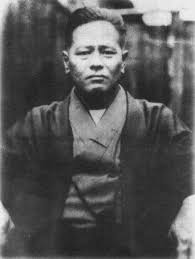
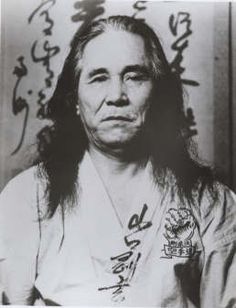
What many newer students may not realise is how close that history actually is. Tino Ceberano Hanshi opened the North Balwyn dojo in 1970, and just two years later, in 1972, Gōgen Yamaguchi Hanshi visited that very dojo. He stood on the same floor, observed the training, and was part of the early development of what continues today. That connection is not distant or abstract — it sits quietly in the background of every class.
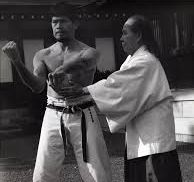
Even when the organisation evolved from Goju Kai karate into IGK in 1990, the respect for the founders of the style and for those who came before has never been set aside. It is carried forward, not announced, but understood.
At the beginning of class, we sit in seiza and close our eyes in mokuso. It is a simple moment, but it changes the state of the room. The noise of the day fades, breathing settles, and attention begins to sharpen. When we bow — to the front, to our seniors, and in a quieter way to ourselves — the class has already begun before a technique is even shown.
As Lambros Kallianiotis Renshi often reminds students, “everything in karate is in the kata.” In the same way, everything in the dojo begins before movement — in how you arrive, how you sit, and how you prepare.
From the outside, the protocols can look formal. Bow when you enter. Ask permission if you arrive late. Step on and off the mat with awareness. Use proper titles. But over time, these actions take on a different meaning. They are not rules imposed from above; they are a way of aligning yourself with what is happening in the room.
Once training begins, the tone of the dojo is set very quickly. There isn’t much unnecessary talking. Instructions are given, and they are listened to carefully. You learn early that if you’re distracted, you miss things — and in karate, small details matter.
The hierarchy in the dojo becomes apparent without needing to be explained. Senior students lead by example, not by assertion. You watch how they move, how they respond, and how they carry themselves. Over time, you begin to understand that rank reflects time, effort, and responsibility. Respect for that is built into the way the class flows.
As John Ross Kyoshi has said, “the dojo runs properly when everyone understands their place within it.” That understanding isn’t forced — it’s developed through consistent practice and awareness.
There is also an expectation in how we respond to instruction. Yudansha are addressed by their title, and when they speak, the response is clear and immediate — Hai. It is not about hierarchy for its own sake, but about acknowledgement, attention, and respect for the experience that has been earned. In the same way, each student is given their due respect, because everyone is part of the same training.
Training itself is always controlled. Techniques are practised with intent, but also with care. You are responsible for your partner’s safety as much as your own. That awareness sharpens your movement and keeps ego in check. You’re not there to win — you’re there to improve, and to help the person in front of you improve as well.
When working with a partner, there is a rhythm that develops. You bow before you begin, and again when you finish. It’s a simple acknowledgement, but it carries meaning. You’ve shared effort, timing, and contact, and you reset, ready to go again.
There is also a quiet expectation around how you present yourself. Uniforms are clean. Nails are kept short. Jewellery is removed, and anything that might interfere with training — even makeup — is set aside. It’s not about appearance for its own sake. It’s about readiness, safety, and respect for the people you’re training with.
There is an understanding around discipline and conduct that becomes clearer the longer you train. Students arrive early, not rushed, but ready. The class begins before the first technique, in how you prepare yourself to step onto the mat.
Once training is underway, you remain present. You don’t leave the floor without permission, and distractions are kept outside. Phones, conversations, and anything that pulls your attention away have no place in that space.
Focus is something that is built, not demanded. Over time, you learn to hold it — not just for a moment, but throughout the entire class.
At the end of training, the group comes back together. Students line up in rank, returning to the same order in which the class began. There is a closing bow, sometimes a moment of stillness again, and the room settles before everyone steps back out into the day.
By this point, it becomes clear that the protocols are not just formalities. They create the environment that allows training to take place properly. They hold the standard of the dojo, ensure safety, and give each person the space to learn, improve, and contribute.
Over time, these protocols stop feeling like something you have to remember. They become part of how you carry yourself. You begin to notice the stillness before movement, the awareness in how you stand, and the way you respond without hesitation.
This is where the idea of Sensei Kōhei begins to make sense. In our dojo, the term refers to the presence and standard of the teacher expressed through the room — not just the person instructing at the front, but the influence that shapes how everyone trains.
The word itself carries a nuance. Sensei is not just “teacher,” but one who has gone before. Kōhei suggests something shared, balanced, and carried together within the group. Put together, it points to something beyond the individual — a collective alignment with the teacher’s standard that is felt throughout the dojo.
You begin to experience it in small ways — how quickly you respond, how you maintain focus, how you correct yourself without needing to be told. It creates the sense that you are being guided and held to a level, even in moments when nothing is being said.
Over time, it becomes clear that the teaching is not only in the techniques or the words spoken, but in the atmosphere that surrounds the training.
Everything in karate is in the kata.
And in the same way, everything in the dojo is in the protocols.
And eventually, without thinking about it, you find yourself pausing at the entrance, bowing as you step onto the mat, and again as you leave — recognising that what happens inside that space is different, and that it deserves to be acknowledged.