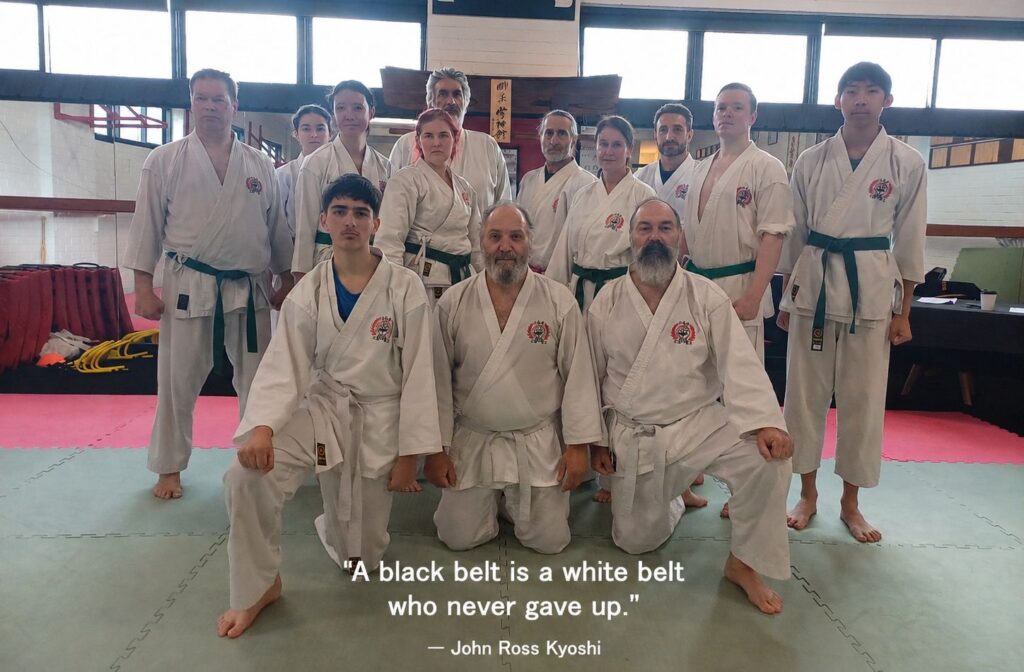

Following our recent grading, John Ross Kyoshi reminded students of a simple truth:
“A black belt is a white belt who never gave up.”
At first glance, grading can seem intimidating. For some students, especially those attempting their first grading, there can be uncertainty about what lies ahead.
Interestingly, two of our adult white belts, both in their fifties, expressed exactly that feeling prior to the grading. They were thoroughly enjoying their training and had no hesitation about attending classes, but they were less certain about stepping onto the floor to be assessed. Like many students before them, they questioned whether they were ready and whether the pressure of grading would be enjoyable.
As it turned out, both performed very well.
Their experience highlights an important lesson about gradings and indeed about martial arts training itself.
A grading is not designed to catch students out. It is not an exercise in embarrassment or a search for perfection. Rather, it is an opportunity to demonstrate what has been learned through regular training. It allows students to challenge themselves, perform under a little pressure, and discover that they are often more capable than they realise.
This is one of the reasons gradings are such a valuable part of martial arts.
The physical skills are important, but so too are the personal qualities being developed. Standing in front of instructors, demonstrating techniques, making mistakes, recovering, concentrating, and continuing despite nerves are all valuable experiences.
Many students—children and adults alike—find that the anticipation beforehand is often more difficult than the grading itself.
By the end of the day, most are smiling, relieved, and proud of what they have achieved.
For parents, gradings provide an opportunity to see the progress that may not always be obvious from week to week. Improved coordination, confidence, focus, discipline and perseverance are often on display alongside the karate techniques themselves.
For adult students, gradings can serve as a reminder that growth does not stop with age. The willingness to step outside one’s comfort zone, accept a challenge and put oneself to the test remains just as valuable at fifty as it is at fifteen.
Every black belt began exactly the same way—as a beginner wearing a white belt, learning the basics and wondering if they were capable of progressing further.
The difference was not natural talent.
The difference was that they kept training, kept learning and kept turning up.
A grading is simply one milestone along that journey.
And sometimes the greatest achievement is not the new belt at the end of the day, but the decision to step onto the grading floor in the first place.