
We spend a great deal of time in the dojo looking at technique.
Where are the feet? Are the hips moving? Is the stance correct? Are the shoulders relaxed? Is the block finishing in the right position?
But there is another part of every technique that we can’t see nearly as easily:
The breath.
Try performing a familiar kata while paying attention to your breathing. You may be surprised by what you discover.
Do you breathe naturally throughout the kata? Does the breath accompany the technique? Do you suddenly realise you’ve been holding it? Does your breathing change when you reach a difficult section — or simply when Sensei is watching?
Breathing is automatic. Breathing well while under physical and mental pressure is not necessarily automatic.
And that makes it part of our training.
When Effort Creates Tension
One of the natural reactions to physical effort is to tighten up.
We see it in karate. A student tries to punch harder and the shoulders tighten. A difficult combination approaches and the whole body braces. Someone concentrates so intently on remembering a kata that they suddenly reach the end of a sequence and take an enormous breath.
The harder we try, the more tension we can inadvertently introduce. Yet more tension does not necessarily mean more power.
“When you tighten everything, you slow everything down. You need to learn when to relax and when to apply the power.”
— John Ross Kyoshi
What Happens When We Get Tired?
Breathing becomes particularly interesting when fatigue enters the picture.
At the beginning of a class, almost everyone can look composed. Later, after repeated kihon, demanding stance work or several rounds of kumite, the body begins telling the truth.
Shoulders rise. Movements shorten. Posture changes. Breathing becomes less controlled.
This is not necessarily a failure. It is useful information. Fatigue exposes habits that are harder to see when we are fresh.
“Anyone can breathe comfortably when the training is easy. The test is whether you can maintain your breathing, posture and technique when you’re under pressure.”
— Lambros Kallianiotis Renshi
Then There Is Sanchin
For a Goju karateka, any discussion about breathing inevitably leads us to Sanchin.
Here breathing is not something incidental happening in the background. It is deliberately brought into the practice along with posture, structure, concentration and muscular engagement.
That raises an interesting question. If excessive tension and breath-holding can interfere with free movement, why does Sanchin deliberately train us in such a distinctive way?
The distinction matters. Sanchin is not simply about making the body rigid; its breathing, structure and muscular engagement are deliberate parts of the training.
“The purpose of Sanchin is not rigidity, but control — the harmony of body, mind, breath and tension. The practitioner learns to harmonise the Go and Ju qualities.”
— Lambros Kallianiotis Renshi
Go and Ju
This takes us back to the name of our karate.
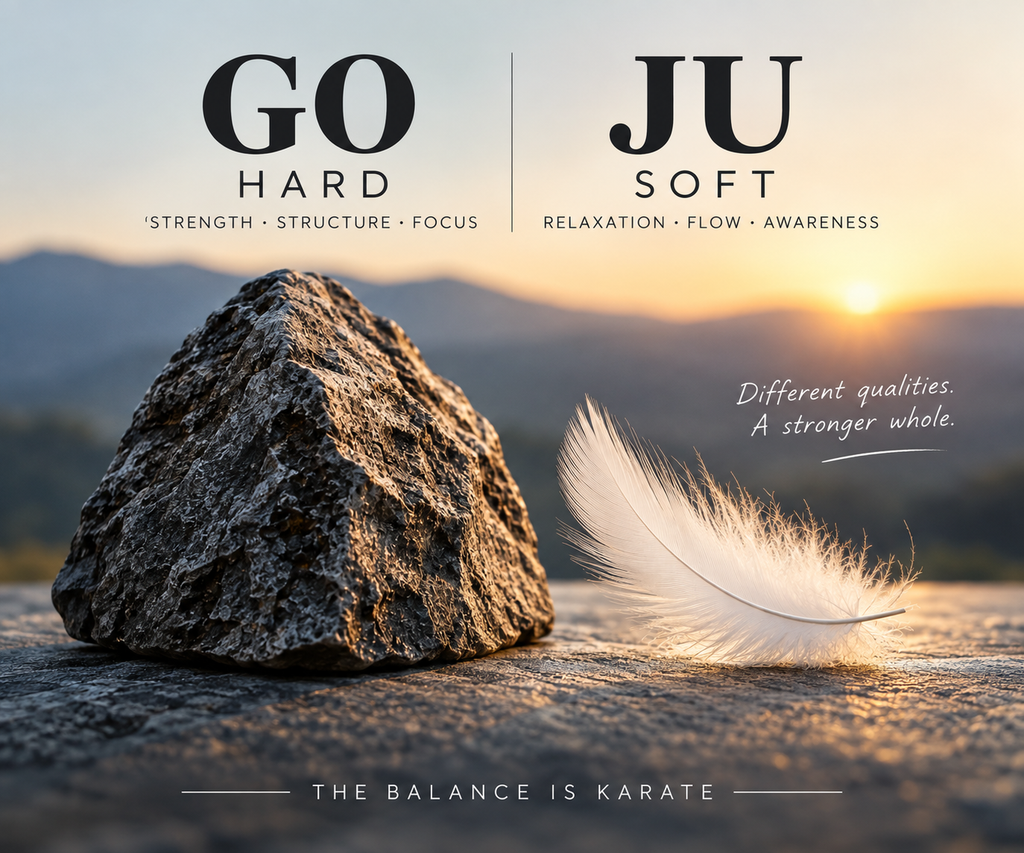
Go — hard. Ju — soft.
Hard does not simply mean tense, and soft does not mean weak.
As our karate develops, we become better at moving between the two. There are moments for muscular engagement and moments for relaxation; moments for explosive power and moments for fluid movement. Our breathing has to work with those changes rather than against them.
“If you’re tense from the beginning of the technique to the end, where is the Goju? You’ve taken the soft out of it.”
— John Ross Kyoshi
The Answer May Already Be There
When we start examining something like breathing, it can be tempting to look for a new technique or a new answer.
Lambros Kallianiotis Renshi often reminds students:
“Within the principles of Goju Ryu lie the answers to many of life’s challenges.”
— Lambros Kallianiotis Renshi
Perhaps breathing is a good example.
Sanchin has been teaching us to pay attention to breath, posture, structure, tension and control all along. The very name Goju reminds us that hard and soft must coexist.
Try Listening to Your Karate
At your next training session, try something very simple.
Don’t deliberately change your breathing at first.
Just notice it.
During kihon, are you breathing throughout the combination?
During kata, are there places where you hold your breath?
When fatigue sets in, do your shoulders rise and your movements become tense?
During kumite, can you remain composed when the pace increases?
And when you’re concentrating particularly hard, ask yourself one simple question:
Am I still breathing?
You may discover something about your karate that no mirror can show you.
And perhaps the final word should belong to John Ross Kyoshi:
“Don’t make breathing another thing to worry about. Train it until it becomes part of the technique.”
— John Ross Kyoshi